(Disclaimer: This Post Contains Affiliate Links. Any Purchase Made Earns me Commission)
The Inmost Light: The Object Focus
H.P. Lovecraft was very fond of utilizing objects as focal points for the Occult. We see this prevalent in a lot of his works including “The Whisperer in the Darkness”, “The Haunter of the Dark” and his Randolph Carter tales regarding the “Silver Key.” Indeed, even “The Call of Cthulhu” has that haunting bas-relief clay tablet, does it not?
While we discussed this from the standpoint of the Black Stone/Black Sigil within Part 2 of this series, I find that there is something important in understanding how Machen utilized the object in one of my favorite stories of his: The Inmost Light. This story focuses on utilizing the occult and the placing of the power obtained from it within an object.
The Inmost Light: Turning a Horror Story on its Head
H.P. Lovecraft, and later August Derleth, liked to place the power of objects as tools utilized by the occult. This is somewhat a hold over from Gothic Horror tales. However, Arthur Machen does something very unique in regards to The Inmost Light. Namely, through the powers of Dr. Black, a man obsessed with the Occult, we have the creation of an occult item.
Yes, we discover through the narration of the story, that sometimes these occult objects aren’t such ancient items. Like The Great God Pan (as we discussed in Part One), we have an attempt to bridge the gap between what is real and the supernatural. In The Great God Pan, there is an act of desecration of the human flesh that leads to seeing Pan. In “The Inmost Light” Dr. Black is so obsessive about his own desire to get acquainted with these dark forces that he rips the soul of his wife from her body and stores it within a hidden jewel.
His wife’s empty body therefore becomes a vessel for the demonic forces to take over.
The Inmost Light: Forbidden Knowledge
Obviously, the found object of H.P. Lovecraft is not the only thing to take from Machen. As we have already discussed, “The Inmost Light” contains a ritual sacrfice of the soul that creates one of these found objects. This fact is so brilliant on the part of Machen, and rarely utilized in horror since. However, there’s also the matter of forbidden knowledge.
In Lovecraft’s works, often, you find the use of the Necronomicon as the gateway to the occult. A lot of people assume that this began with his love of “The King in Yellow” of Robert Chambers, but I would argue that it was at the crux of stories like “The Inmost Light” as well, which was published in 1894: a full year prior to the publication of “The King in Yellow.”
While the latter, of course, has the tie of esoteric texts that draw attention to the supernatural, that should not in any way negate the importance of the forbidden knowledge obtained through dark sciences and alchemy, found within Machen’s works like “The Great God Pan” and “The Inmost Light.”
The Inmost Light: Dark Scientific Discovery
The final point regarding the influence on the Cosmic Horror genre of “The Inmost Light” is the essential use of the dark sciences. While everyone loves to focus on the Necronomicon as the genesis for the oddities and evils perpetrated by humans, is it not through the dark sciences that we see the rituals in many of Lovecraft’s works?
In “The Case of Charles Dexter Ward” you have a man totally obsessed, much like Dr. Black, with the uses of the dark sciences to destroy the fabric of nature. Digging up bones, and resurrecting the dead. This is where and why H.P. Lovecraft is lauded as the genius of horror that he is, after all.
H.P. Lovecraft takes an idea of Machen’s (namely, the use of dark sciences to undo the natural), marries it with knowledge from a source such as the Necronomicon, and creates a whole new vein of Horror. In a way, Charles Dexter Ward subverts what Dr. Black did, after all. Rather than finding and removing The Inmost Light (the human soul), extracting it from the center of a person, he manages to utilize the dark alchemies of Black to place that soul back into a body.
This is how H.P. Lovecraft not only, brilliantly, pays homage to one of his influences. He takes a whole new spin on it to the point where it takes a real dissection of the material to get to the “Inmost Light” of the stories as they pertain to one another.
Read Arthur Machen’s Works
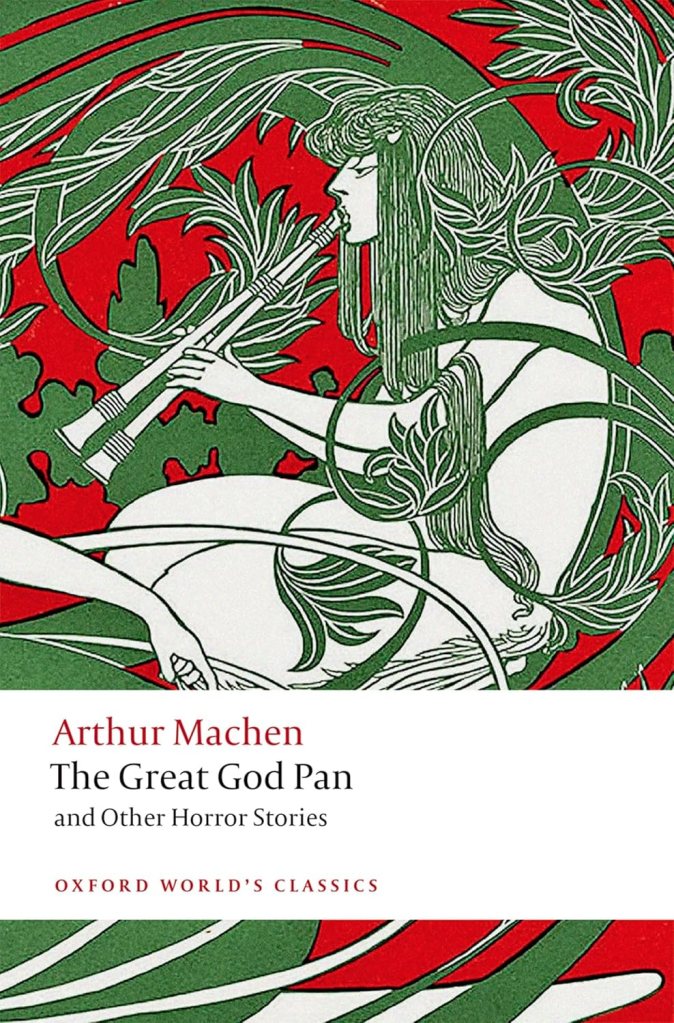
Arthur Machen “The Great God Pan and Other Horror Stores”
Tentacles and the Occult: Arthur Machen’s Impact on Lovecraft (Part 2)
(Disclaimer: This Post Contains Affiliate Links. Any Purchase Made Earns me Commission) The Three Imposters Arthur Machen mostly delved into shorter fiction, whether it was true short stories, novelettes (The Inmost Light) or novellas (“The White People” or “The Great God Pan”). Like Lovecraft, his novel writing was sparse (in Lovecraft’s case his only true…

Tentacles and the Occult: Arthur Machen’s Impact on Lovecraft (Part 1)
By now it is no secret that H.P. Lovecraft was a voracious reader. There was a select group of writers that helped forge his craft and focus on the cosmic. Perhaps none had a greater impact than Arthur Machen. Machen was the Welsh Wizard: he dove deep into the folklore of the region and turned…
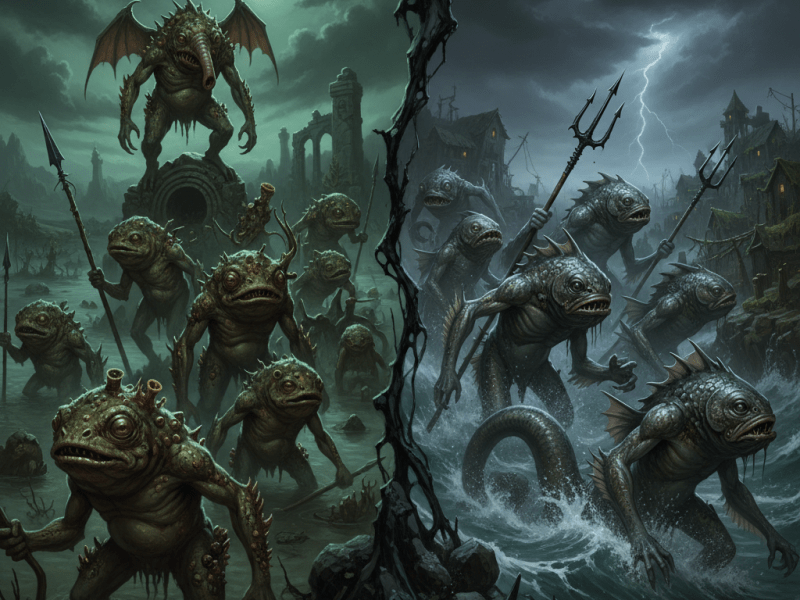
The Sarnath-Innsmouth Connection: Are the Beings of Ib Just Primordial “Deep Ones”?
(Disclaimer: this post contains afflliate links) In my last entry, we discussed the lore of the Deep Ones of Innsmouth legend. Interestingly, there is another creature which cannot remain anonymous that is involved in even more esoteric and ancient lore written about in ‘The Doom that Came to Sarnath.’ Is it possible these Creatures of…
 Old Ones Keeper
Leave a comment